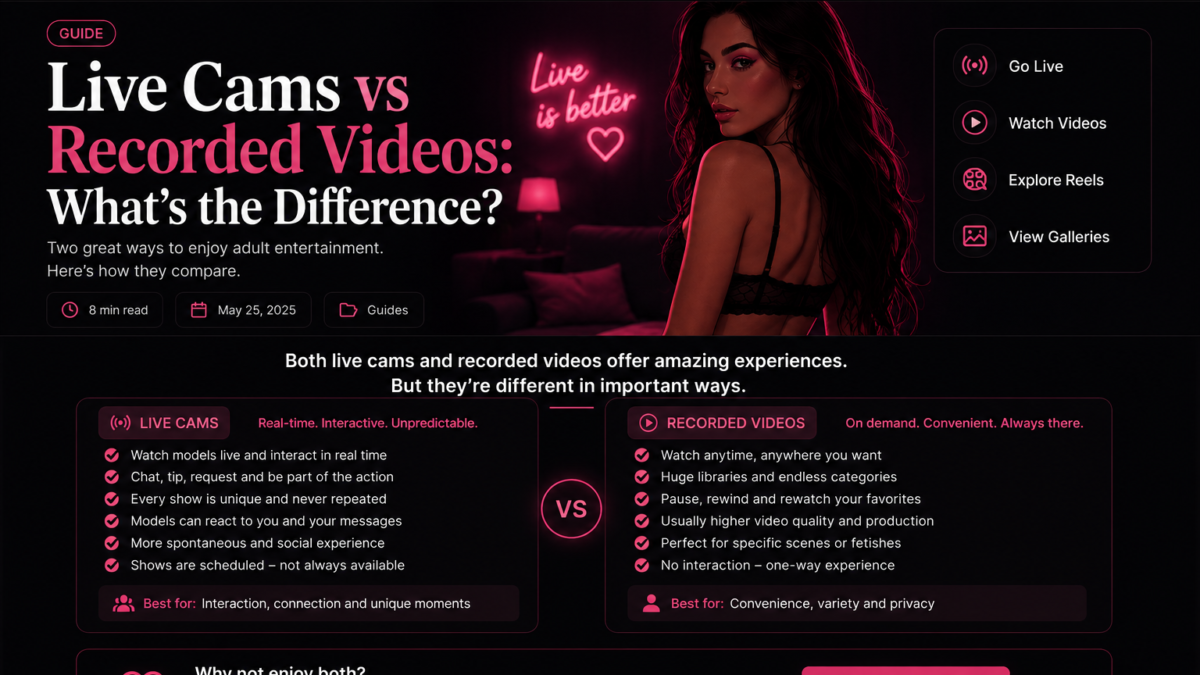
Live cams and recorded videos are two of the most popular ways to explore online video content, but they offer very different experiences. One happens in real time and may include direct interaction, while the other is available on demand and gives viewers more control over when and how they watch.
Neither format is automatically better. The right choice depends on whether you value immediacy, interaction, convenience, stable video quality, playback controls, or the ability to return to the same content later.
This guide compares live cams vs recorded videos, explains the main differences between them, and helps you decide when to use live streams, traditional videos, short-form reels, or image galleries.
What Is a Live Cam?
A live cam is a video broadcast happening at the same time the viewer watches it. A model or creator transmits video through a webcam, smartphone, or dedicated streaming setup, and the platform delivers that broadcast to viewers currently inside the room.
Because the content is live, the experience can change from one moment to the next. The creator may communicate with viewers, react to public messages, change the room setup, begin a new activity, or end the stream without advance notice.
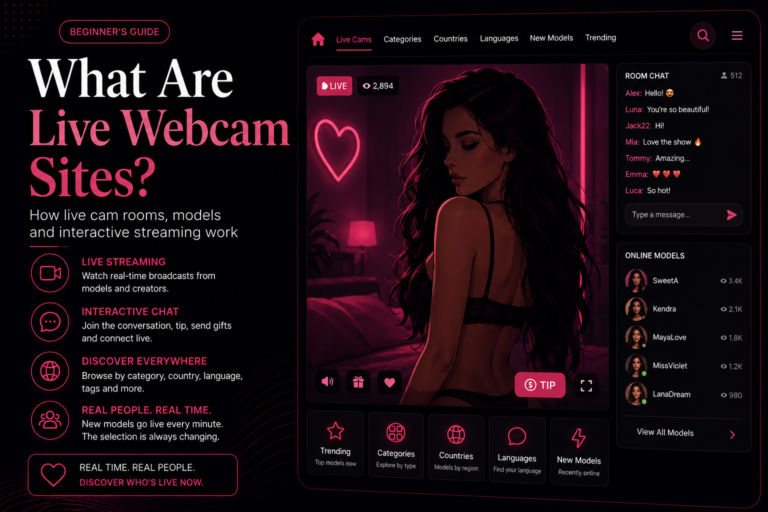
A typical live cam room may include:
- A real-time video player
- A public chat area
- Current viewer numbers
- A model profile
- Follow or favorite controls
- Tips, goals, or virtual gifts
- Private or group room options
- Language, country, and category information
The main attraction of live cams is their immediacy. The exact moment being broadcast is temporary and may never be repeated in the same way.
What Is a Recorded Video?
A recorded video has already been created and uploaded before the viewer opens it. It may be a short clip, a longer video, a highlight, an edited production, or content associated with a particular creator.
Unlike a live stream, recorded content is normally available whenever the viewer chooses to watch it. It can often be paused, replayed, skipped forward, viewed in fullscreen, or reopened later.
A recorded video page may include:
- A standard video player
- A thumbnail or poster image
- A title and description
- Categories and tags
- Related video recommendations
- Creator or sponsor information
- View counts, ratings, or other engagement data
The biggest advantage of recorded video is control. The experience does not depend on whether a creator is online at that exact moment.
The Main Difference: Real Time vs On Demand
The clearest difference between live cams and recorded videos is timing.
Live cams happen now. The viewer joins an active broadcast and sees what the creator is doing at that moment.
Recorded videos are available on demand. The viewer chooses when to start, pause, replay, or stop the content.
This difference affects almost every part of the viewing experience, including interaction, availability, playback controls, quality, and how easily the same content can be found again.
Interaction and Communication
Live cams are generally more interactive than recorded videos. Depending on the original platform, viewers may be able to send public messages, react to the broadcast, tip, follow the creator, or access additional room features.
The model may respond immediately, creating a more personal and unpredictable experience. Even viewers who do not participate can still watch the room change as the creator reacts to the live audience.
Recorded videos do not normally provide direct interaction while the content is playing. Comments, likes, or ratings may be available, but they happen around the video rather than as part of a live conversation.
Choose live cams when real-time communication and audience activity are important. Choose recorded videos when you prefer to watch privately and without participating.
Availability
A live model must be online before the room can be watched. Broadcast schedules can change, and creators may appear at different times depending on location, personal routine, or platform activity.
A recorded video remains available as long as it continues to be hosted by the platform or content delivery network. It can normally be opened at any hour without waiting for a creator to start broadcasting.
This makes recorded videos more convenient for viewers with limited time or irregular schedules.
Live cams are better suited to people who enjoy checking who is currently online and exploring a selection that changes throughout the day.
Playback Control
Recorded videos usually provide more control over playback.
Common options include:
- Pause and resume
- Skip forward or backward
- Replay selected moments
- Adjust the volume
- Enter fullscreen
- Change playback speed
- Return later and continue watching
Some live players allow pausing, but the original broadcast continues in real time. When the viewer resumes playback, the player may return to the current live moment instead of the exact point where it was paused.
For maximum control, recorded videos are usually the stronger format.
Spontaneity and Predictability
Live cams feel more spontaneous because the content is not completely predetermined. Even when a creator follows a familiar room format, the audience, conversation, timing, and activity can change.
Recorded videos are more predictable. The title, thumbnail, duration, and description generally provide a clearer idea of what the viewer will see before pressing play.
People who enjoy surprise and real-time activity may prefer live cams. Those who want to make a quick and informed choice may prefer recorded videos.
Video Quality and Reliability
Recorded videos often provide more consistent image quality because they can be processed and encoded before publication. Platforms may offer several resolutions and deliver the file through a CDN optimized for stable playback.
Live video quality depends on more variables:
- The creator’s internet connection
- Camera and lighting quality
- Streaming bitrate
- Platform capacity
- The viewer’s connection speed
- Distance from the streaming server
- Current network congestion
A live room can look excellent, but it is more vulnerable to buffering, temporary resolution changes, pauses, or connection problems.
Recorded videos are generally more reliable when stable quality is the main priority.
How Content Is Organized
Live cam directories and video archives organize content differently.
Live cam pages usually prioritize:
- Who is online now
- Current viewer numbers
- Trending rooms
- Recently online models
- Country and language
- Live categories
Recorded video archives usually prioritize:
- Titles and descriptions
- Categories and tags
- Upload date
- Popularity or views
- Related clips
- Search keywords
You can browse models currently live when you want a real-time experience or open the video archive when you prefer stable, searchable content.
Live Cams Are Better for Finding Active Creators
A live directory makes it easy to see which creators are broadcasting at that moment. Live indicators, previews, viewer counts, categories, and recent activity can help identify rooms worth opening.
This is useful when you want to:
- Find creators who are online now
- Join an active room
- Compare current popularity
- Browse different countries and time zones
- Experience a creator’s live presentation style
The selection changes throughout the day, so returning at another hour can reveal a completely different group of models and rooms.
Recorded Videos Are Better for Search and Repeat Viewing
Recorded videos are easier to organize using stable URLs, titles, keywords, categories, and tags. A useful video can be bookmarked and opened again without depending on a live schedule.
This makes recorded content better for:
- Searching for a specific subject
- Watching at any time
- Replaying a favorite clip
- Pausing and continuing later
- Browsing related videos
- Sharing a stable page
The main limitation is that the experience is less immediate. The creator is not reacting to the viewer in real time.
Mobile Viewing
Both formats can work well on smartphones and tablets, but they create different technical demands.
Live cams may require:
- A stable internet connection
- Continuous bandwidth
- A responsive player
- Touch-friendly chat and controls
- Keeping the browser active during playback
Recorded videos can buffer ahead, making them more tolerant of temporary connection changes. They also allow viewers to pause when moving between locations or networks.
Short-form vertical reels are especially suited to mobile browsing because they display one clip at a time and use swipe-based navigation.
Data Usage
Live cams can use a significant amount of data because video is delivered continuously for as long as the room remains open.
Recorded videos can also consume substantial data, but viewers generally have more control over how long they watch and when playback stops.
Data usage depends on:
- Video resolution
- Bitrate
- Viewing duration
- Autoplay behavior
- The number of previews loaded
- Whether the connection uses mobile data or Wi-Fi
When using a limited mobile connection, shorter recorded videos or reels may be more practical than keeping a live room open for a long period.
Privacy Considerations
Public live rooms can often be viewed without participating, but interactive features may require an account. Recorded video pages may also include favorites, subscriptions, comments, or payment systems.
Basic privacy precautions apply to both formats:
- Use a unique password for each platform
- Avoid sharing private information publicly
- Review payment details before confirming a transaction
- Check subscription renewal conditions
- Use official links and payment systems
- Avoid suspicious downloads or extensions
- Read the platform’s privacy policy
Live chat deserves additional care because public messages may be visible to other viewers. Keep personal details out of public conversations.
Live Cams vs Recorded Videos for Discovery
The most useful discovery method depends on how you prefer to browse.
Live grids display several online models at once. This is useful for comparing current availability, viewer counts, categories, countries, and providers.
Recorded video pages use thumbnails, titles, tags, and related recommendations to help viewers move through a stable archive.
Reels offer a third option. They show one short clip at a time, reducing visual clutter and making discovery faster on both mobile and desktop.
A complete browsing strategy can combine all three:
- Use reels to discover an unfamiliar visual style.
- Open related recorded videos for longer viewing.
- Return to the live directory to see who is broadcasting.
- Save interesting models or pages for later.
Where Do Galleries Fit In?
Image galleries provide another way to explore content without loading continuous video. They can be useful when you want quick visual browsing, lower bandwidth usage, or a stable collection of images.
Compared with live cams and videos, galleries offer:
- Fast scanning
- No video buffering
- Lower data consumption
- Simple mobile navigation
- Easy access to multiple images
You can browse the gallery archive when continuous video playback is not necessary.
Which Format Is Better for New Viewers?
Recorded videos are often easier for beginners because the interface is familiar and the viewer controls the pace.
Live cams can feel more complex because they may include chat, viewer numbers, provider controls, goals, account features, and rapidly changing availability.
A simple starting process is:
- Browse a few recorded videos.
- Explore short-form reels.
- Open the live directory.
- Choose a room with a clear preview.
- Watch publicly before using interactive features.
This gives new viewers time to understand the platform before entering more active rooms.
Which Format Is Better for Returning Viewers?
Returning viewers may prefer live cams when they already know which models, categories, countries, or providers they enjoy.
They can check favorites, see who is online, and move directly into a current broadcast.
Recorded videos remain useful between live sessions. They provide stable content when favorite creators are offline or when the viewer wants something specific rather than a changing live room.
Advantages of Live Cams
- Real-time broadcasts
- Direct interaction
- A constantly changing selection
- Visible current activity
- Spontaneous moments
- Immediate access to active creators
Disadvantages of Live Cams
- Models may be offline
- Streams can buffer or disconnect
- Playback control may be limited
- The same moment may not be available again
- Long sessions can use significant data
- Interactive features may require registration
Advantages of Recorded Videos
- Available on demand
- Pause, replay, and seek controls
- More consistent quality
- Stable URLs and archives
- Easier search and categorization
- Convenient for limited schedules
Disadvantages of Recorded Videos
- No real-time interaction
- Less spontaneity
- Large archives can become repetitive
- Some videos may be removed or expire
- Thumbnails may not fully represent the clip
When Should You Choose Live Cams?
Choose live cams when you want:
- A real-time experience
- Creators who are online now
- Public chat or interaction
- Spontaneous broadcasts
- A selection that changes throughout the day
When Should You Choose Recorded Videos?
Choose recorded videos when you want:
- Complete playback control
- Content available at any time
- A stable archive
- Better search and categorization
- The ability to replay or bookmark a clip
Frequently Asked Questions
Are live cams better than recorded videos?
Not in every situation. Live cams are better for interaction and immediacy, while recorded videos are better for convenience, playback control, and repeat viewing.
Can live cam streams be paused?
Some players allow pausing, but the original broadcast continues. When playback resumes, the viewer may return to the current live moment instead of the exact point where the stream was paused.
Do recorded videos use less data?
Not automatically. Data usage depends on bitrate, resolution, and viewing time. Recorded videos provide more control over when playback stops, while live streams continue using data for as long as the room remains open.
Why do live cam rooms sometimes stop loading?
The creator may have ended the broadcast, the provider may be experiencing a temporary issue, or the stream may have paused after the player was hidden or the browser tab lost focus.
Are reels the same as recorded videos?
Reels are a type of short-form recorded media, usually shown in a vertical feed with one clip visible at a time. They are designed for fast discovery rather than traditional archive browsing.
Can I watch live cams and videos on mobile?
Yes. Most modern platforms support mobile browsers, although performance depends on the player, device, connection speed, and responsive design.
Live Cams and Recorded Videos Work Better Together
Live cams and recorded videos serve different purposes. Live streams provide real-time activity, interaction, and constantly changing rooms. Recorded videos provide convenience, stable playback, and content that can be searched and revisited.
There is no need to choose only one format. Reels can help you discover something quickly, videos can provide longer viewing, galleries offer lightweight browsing, and live cams connect you with creators who are active right now.
Using each format for what it does best creates a more complete and flexible browsing experience.
Choose how you want to explore
Browse live models now or open the video archive for content available on demand. Explore Live Cams Browse Videos